ラベル problem の投稿を表示しています。 すべての投稿を表示

日曜日, 2月 27, 2011

Cruise Ships, Oysters, and Pro-Snowboarders

Sunday, February 13th, was going to be your standard day working at a reception for a cruise ship.

I was not excited to wake up before 6:30 a.m.
I had to meet up with the Port Promotion Bureau folks and welcome the 1,200 British passengers off a 45,000 ton cruise ship called "Artemis" at 7:45, in a suit. Since I took the last week off to go to Hokkaido, I was too exhausted Saturday to go to the Snowboard World Cup in Hiroshima I had been anxiously anticipating, and spent the day sleeping and doing laundry instead. This meant that Sunday morning, after donning my suit, I rode my bicycle to the International Center (which was still closed), and let myself in to the dark and lonely office to print out the speeches I'd be giving at the welcome ceremony that afternoon.

I managed to catch a street car from there to the port, on time, and say good morning. It had been almost a year since the last time I had gone there for a job like this, but I have done it so many times that I was very relaxed, almost to the point of being nonplussed. All of my co-workers (from various different government divisions) were all first-timers though, and so between changing money and helping directions into town and the occasional computer problem (there were a few PCs set up with the ever-coveted internet access), there was a whole lot to do in the A.M. so we got to know one another and shared small talk as tour buses shuttled the passengers to and fro by the dozens.

When lunchtime came, I left the information center thinking I'd grab a convenience store bento, and to my surprise a full fledged oyster festival had been set up next to the pier while I was inside. I went over to take some photos and check for interesting yatai (food stall) treats.

As I started to walk away I was greeted by who else, but Morikawa-san, my supervisor at the kencho, and her husband whom in two and a half years of working together I had still never met. Not only that, her sister and sister's husband where also there! They came to grill some fresh oysters for lunch and invited me to join them, their treat! We had a great time, talking, admiring the enormous cruise ship berthed behind us, and grilling and eating Hiroshima's famed oysters, along with scallops, turban shells, and some fried rice. I felt bad about being treated to all this great food so I ran back to the food stalls and picked up a pack of strawberries to share for dessert. Then I said my farewell and went back to the information center.


Morikawa-san's sister and her husband


Turban Shells (サザエ) look awful, it's true, but they are good!


What a great set-up, no?


Scallops (ホタテ)


After a couple more hours helping out passengers, it was time to gather everyone who was going on board for the welcome ceremony. We lined up at the security desk at the base of the gangway and i translated while everyone traded their I.D.s for passes to get on-board. There were also 10 young women from the Hiroshima municipal firefighter's band with us who would be performing for the passengers at the ceremony, but apparently everyone EXCEPT security knew about this, and we were severely delayed getting on board. By the time everyone was in the performance room, set up, and ready to go, we were half an hour behind, which was terrible because we also had to be OFF the ship in time for them to begin their departure prep for their next leg to Korea.

"Okay, we'll just cut the Japanese MC"... said THE JAPANESE MC. He's a laid back dude, I had done this with many times the previous year and he always joked that I should do it myself. This time though, he wasn't joking. So right then and there, I had to grab a mic, pretending like we had planned for this all along, and set in front of a standing-room-only theater of about 500 passengers, and MC the entire thing, based off the script I had prepared that morning as a translation of what he was meant to have said in Japanese first. In terms of the words coming out of my mouth, this was not much different, I just didn't have to wait for him to say it in Japanese, but the reality of the situation was I was no longer standing off to one side speaking calmly into a mic, but stood front and center and engage the crowd. And may I just say: *Nailed it!*
This is the only photo I had time to take, because I was busy MCing!

Beautiful, right?

After the band finished performing the ceremony was over and we all got off the ship and waved goodbye. An awesome end to a day's work, I thought...but it didn't end there.
Baked mac&cheese = Heaven
I decided to treat myself to dinner at my regular bar, Southern Cross, and as I ate from their menu (baked macaroni and cheese and a BLT) I got a call from Warren, a friend I hadn't seen for awhile, who basically said to wait up, and he'd join me for a couple drinks and discuss our mutual, recently non-existent love lives. As we did this, a crowd of about 14 of the whitest most obviously European looking people you'd ever imagine seeing, poured in with one Japanese family. The bar had been pretty quiet until then, but these guys were there to party, and as calls of "Prost!" rose through the air, I had to ask them, "What brings you to Hiroshima?" in my horrid, rusty German.


"We were part of yesterdays tournament" said the girl who turned out to be Marion Kreiner - Austrian Vancouver Winter Olympics bronze medalist. What?!? Wait... no... I thought, and as the reality of the situation sunk in around me... "So she's (pointing to the only young Japanese woman in the room) Takeuchi-san??" I asked slowly. "Yeah, Tomokaaaa"Marion called and the next thing I knew I was chatting with ANOTHER Olympic medalist and the spokeswoman for the event I had missed the day before, and of course, getting our picture taken!
Warren, Tomoka, and her uncle, a long-time resident of Hiroshima and cool dude.

I had the next day off (thank god) so i stuck around for a few more hours, drinking and chatting with all of them, including Swiss snowboarding Gold medalist and all-around nice guy Simon Schoch, and got all of them to sign a post card from the Artemis which I then mailed (in an envelope, duh) to my brother. It was truly a day AND night to remember.
Everything you need to know about Doris Günther

金曜日, 1月 14, 2011

Humanity, Struggle, and the Fallacy of Peace?

When I started this blog seven months ago, I was already quietly starting to question whether "World Peace" is impossible, or even an unreasonable, ideal.

Back in my high school days I read this comic called Johnny the Homicidal Maniac:
This specific issue dealt with the concept of heaven, and in the authors imagination, heaven was a place without conflict, and free from want, which meant everyone sat around, completely still, and utterly content. At the time I did not think critically about society, but was getting deeply interested in religion and the content it espouses. If you were free from sadness, I thought, would joy even exist in its absence? Would you be moved from pure bliss to sing God's praises as so many paintings and stories of angels suggest, or would you, freed from all desire, just... sit there? I decided I do not wish to be free of desire. I want motivation to move, to act, to improve my situation and surroundings. After life ends, I may be faced with choosing between this world or contented perfection, but I doubt it, and I will put that aside for the rest of this conversation. But still, I think of this comic often, because now as I ponder the living world, I have to conclude that, my blog title still holding: If life were easy, it would be sooo boring!

I will not entertain the concept that you cannot improve your situation without putting someone else at a disadvantage. Most such modern philosophy quickly devolves into hyperbole-rich, hypothetical, meaningless pontification. What I do look to for the big-"T"-Truth, is the natural world, especially animals.

From the biological viewpoint, if humans had no new challenges, we would cease to evolve right? My logic for this comes from crocodiles. Basically the most successful dinosaur ever. It's a giant lizard, that swims, walks, and kills, and does it all with a smile. They have always lived in the same place, had plenty of food available to them, and reproduced unchallenged. So even after hundreds of millenniums passed, they stayed the same. I know that as a human, I will not do or see much  human evolution in my lifetime (indeed, sometimes it seems like I can see the opposite!), but the thought of humans staying the same in physical and mental limitations and ability for another million years is a depressing one.
It's not too late. To whip it. Whip it good.

I thought about this, on a very personal scale, for years. Challenge, goals, mile posts, and even set-backs can all be good things for learning and growing. Then about three years ago, I moved to just outside the Peace Park in Hiroshima City, formerly Ground Zero for the first atomic bombing on an actual target, and began my current job, including lots of reading and translating regarding that subject.

I want to make something crystal clear before continuing: I am absolutely, and unabashedly against the very existence of nuclear weapons, their proliferation, and the absurd thought that by having them, you are any safer. Living here, learning about every aspect of atomic weapons, from scientific creation and application, to resulting devastation and lasting turmoil; and above all meeting and working with actual atomic bomb survivors, has taught me beyond a shadow of a doubt that no space in humanity exists for ANY weapon with such lasting and wide spread repercussions.

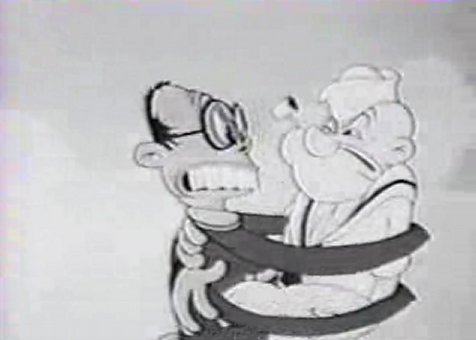
One thing I never hear anyone say as a reason for why we should abolish nuclear weapons: human conflicts don't last long enough to justify their use. Every last soul in country A and country B could hate each others' guts, and feel it justified in their hatred, but 56 years later, where are the first two foreign countries this American visits, the first international friends I make, and the best time of my life experienced? Germany and Japan. The "Krauts" and "Nips" that Popeye cartoons stereotyped in prime, racist fashion during the war. Even in the '80s I remember watching these cartoons repeated on television, although I didn't understand fully what I was watching. Despite Hiroshima proving to be more resilient in its recovery than any scientists estimated, it is still not fair to your own offspring to inflict such lasting damage on a people, since decades later when you are dead and gone, the children who survived your atrocities are now having to cope with being around your children, who also had absolutely zero say in the matter, and just want to get along in peace.

But WMDs aside, is it natural to wage war? "Huh! Good god!" Is it really good for "absolutely nothin!"? Obviously not; human evolution, technological development, and history, have come from fighting a series of wars. The first tools, fire, and shelter, can be thought of as developments from war with our environment for to survive. Castles, jets, satellites, and and many advances in medicine came out of necessity from being at war with other countries. Even in the business world, we call competition that leads to lower prices, "Price Wars".


But back to nature. Plenty of examples of war exist in nature. Chimpanzees, and dolphins are thought to be some of the closest to humans in terms of intelligence. Perhaps that is why dolphins will play with and even save humans they find in the ocean, the same way we coddle and care for other species which we find cute. Yet that same pod of dolphins may willfully go scouting and attack other clans of dolphins. Recently, videos of Japanese bees and wasps waging war against each other have become viral videos on YouTube and you can see there and on National Geographic videos about ants, that even very low-intelligence, hive-minded insects wage war.

I am not condoning war, but my current working philosophy is that war is at least natural. Possibly at the core of the heavy losses and devastation to life, nature, and humanity that have accompanied wars over the last century, is our own foolish pride and attempts, through complicated treaties, embargoes, and alliances, to avoid small wars between specific groups. Instead we strain both sides and threaten their sovereignty for merely acting in the best interests of their people. We always refer to small waring regions as "unstable", but what if they are unstable before fighting breaks out, and war is their way of stabilizing?

A microcosm of our current predicament can be seen if we look at the history of North American Plains Indians. For centuries many had a tradition of counting coup. Despite constant tribal wars, casualties were low, because prestige, or making your enemy look like a fool, was prized higher than killing. The introduction of deadlier weapons from European settlers escalated the scale of tribal wars, and because of a gun's obvious advantage the Plains Indians began using them and conflict resolution went from making the enemy look bad, to outright kill-or-be-killed.

Some may argue that the progression of technology is to blame. Now that guns and nuclear weapons exist, there is "no going back". Again, I disagree. I don't see any need to go backwards technologically, but most of society has to change their unrealistic expectation that there is never a need for violence. Physical violence may be brutal and animal, but to deny ourselves that part of our evolution is denying we too are animals. If you look at the proportionate strength of wild animals to modern man, we are a pretty pathetic lot. This was probably not the case before, but physically, each new generation seems less able to perform manual labor, and mentally less able to express their problems, resolve them, and move on.

Ultimately, I believe the only way to fix society's problem with war and conflict in general, requires a mental shift, and that starts with how we ourselves think and what lessons we pass on to the next generation. Religious holy war-waging lunatics have the advantage, since their dogma also includes a doctrine to have as many children as possible, but if they are forced to interact with sounder, more well-rounded children in their schools and playgrounds, maybe the notion that "it's okay to fight through something" will return to society, along with something much closer to actual peace than what we have today.

Not a whole lot to speak of in my personal life, so I will rant next about Japan's English education and American political shortcomings next. It will hopefully be a little more stimulating than how that just sounded though :P

In the meantime, leave a comment and let me know what you think. Am I totally off my rocker, or does this make sense?
          
Love, Peace, and War!
greg